Confidential Onramping on Solana: Fiat Straight to a Private Balance
In this article: Public stablecoin settlement exposes sensitive business information
On November 13, 2026, three days after Helius launched Solana Privacy Rings on mainnet, we completed the first ever confidential onramp: a user paid with fiat, and USDC landed in their private balance in a single flow.
Any app can offer confidential onramps by adding one parameter to a Crossmint Onramp order.
Encrypted balances have existed on public chains, but getting money into one meant buying stablecoins into a public wallet first. Funds sat in a visible balance before they became private, which defeated the purpose. Confidential onramping skips the public wallet entirely.
“Onramps are secretly the most important part of onchain privacy,” says Mert Mumtaz, CEO of Helius. “Without them, you’re leaking full information to the world at the boundaries, and relying on time to cover your tracks. With them, you have bank-grade privacy by default. And for that to work you need to work with a world-class team of high integrity, of which Crossmint is unparalleled.”
Below, we cover what Privacy Rings encrypt, how the onramp works, what it means for enterprises running treasuries and payouts onchain, and how to integrate.
Public stablecoin settlement exposes sensitive business information
On Solana, every token balance and transfer is visible to anyone who knows the address. That openness makes the chain easy to verify. For a business, though, it means operating with its books open. Information that companies normally guard closely, and are often contractually bound to keep confidential, ends up on a public ledger.
Consider what a company’s wallets reveal. A treasury wallet shows competitors how much the company holds and when it moves funds. A payout wallet shows what every contractor or employee is paid, information that companies keep private even internally. A settlement wallet shows which suppliers the company uses, how much it pays them and how often, letting rivals map its supply chain and counterparties. With analytics tools, these records can be joined together within minutes.
Individuals face the same exposure, since a public balance shows anyone what they hold and where they spend it. For payment and treasury teams, that exposure is enough to keep stablecoin activity small or offchain. The rails are fast and cheap, but exposing sensitive information holds back adoption.
How Crossmint's confidential onramp works
A confidential onramp is a standard Crossmint Onramp order with one key difference: where the stablecoins are delivered.
Payment, compliance checks, limits and records work the same as for any onramp order. The only change is the last step. Instead of sending the stablecoins to the user's public account, Crossmint deposits them into Privacy Rings and credits them to the user's encrypted balance.
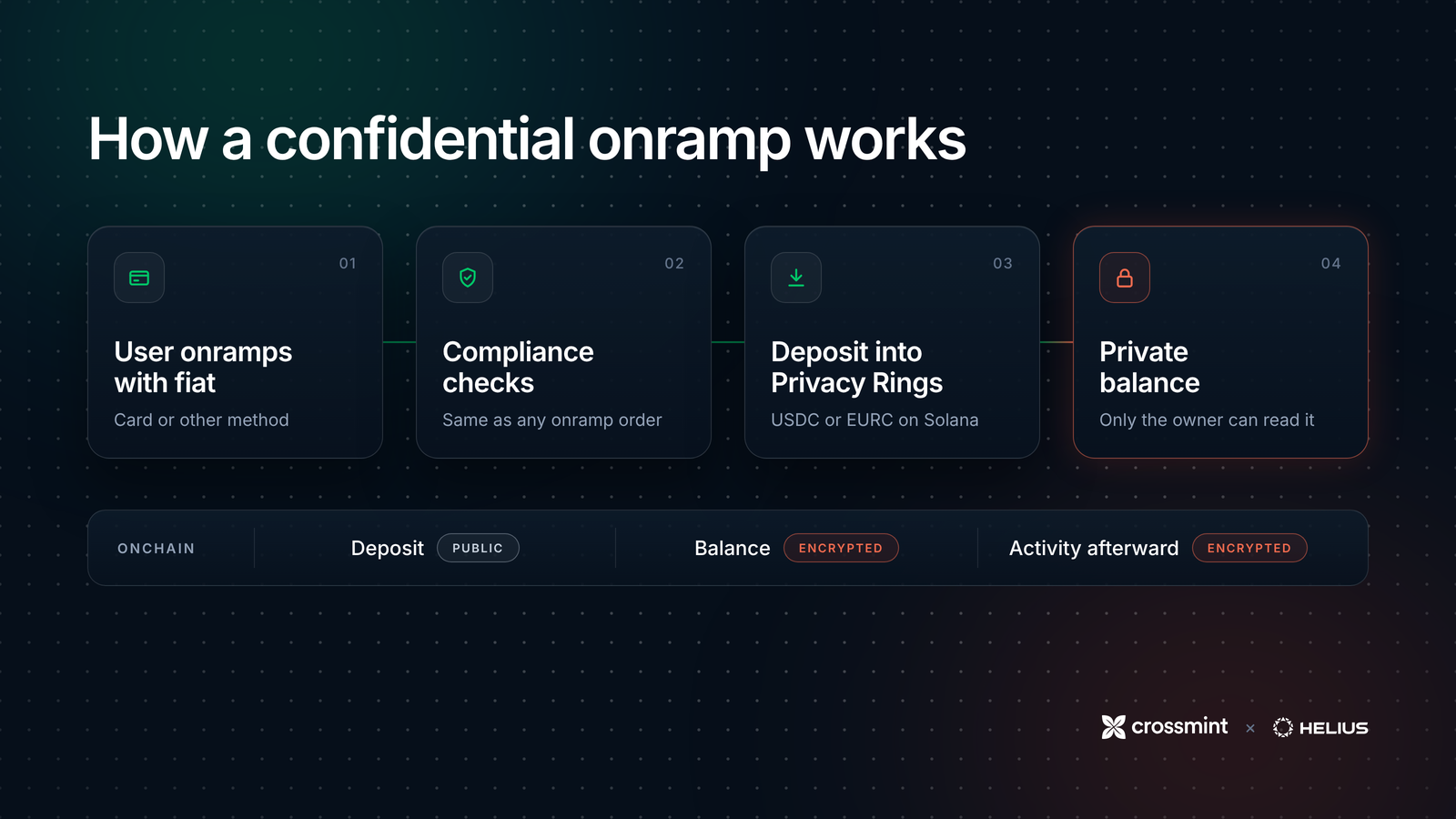
- The app creates an onramp order with
executionParameters.deliveryset to"private"and the user's Solana address as the recipient. - Crossmint checks eligibility before the user pays. It confirms the token and chain are supported and reads the onchain registry to confirm the recipient has a Helius Private Wallet.
- The user pays with fiat inside the Crossmint Onramp, by card or another supported method.
- Compliance checks run as usual with sanctions and wallet screening, limits, and Travel Rule ownership proof where it applies.
- Crossmint deposits into the Privacy Rings. USDC or EURC moves into the Privacy Rings pool and is credited to the user's private balance in one Solana transaction.
- The user holds and spends privately from their Private Wallet. Only they can read the balance.
If the recipient's Private Wallet is missing, Crossmint never sends the stablecoins to a public wallet. The order is cancelled and the user is refunded.
In this initial release of confidential onramp, the deposit itself is a visible transaction. The recipient address, token, and amount are public. What becomes private is the balance the deposit creates and everything the user does with it afterwards. We are building a v2 to encrypt the asset and amount as well.
From fiat to Privacy Rings: what confidential onramps unlock for enterprises
Encrypted balances let a business settle in stablecoins without publishing its books. For Crossmint’s enterprise customers, the confidential onramp is the entry point. It puts funds into a private balance without routing them through a public one. From there, Privacy Rings support the three workflows where public settlement exposes the most: treasury, payouts and payroll, and B2B settlement.
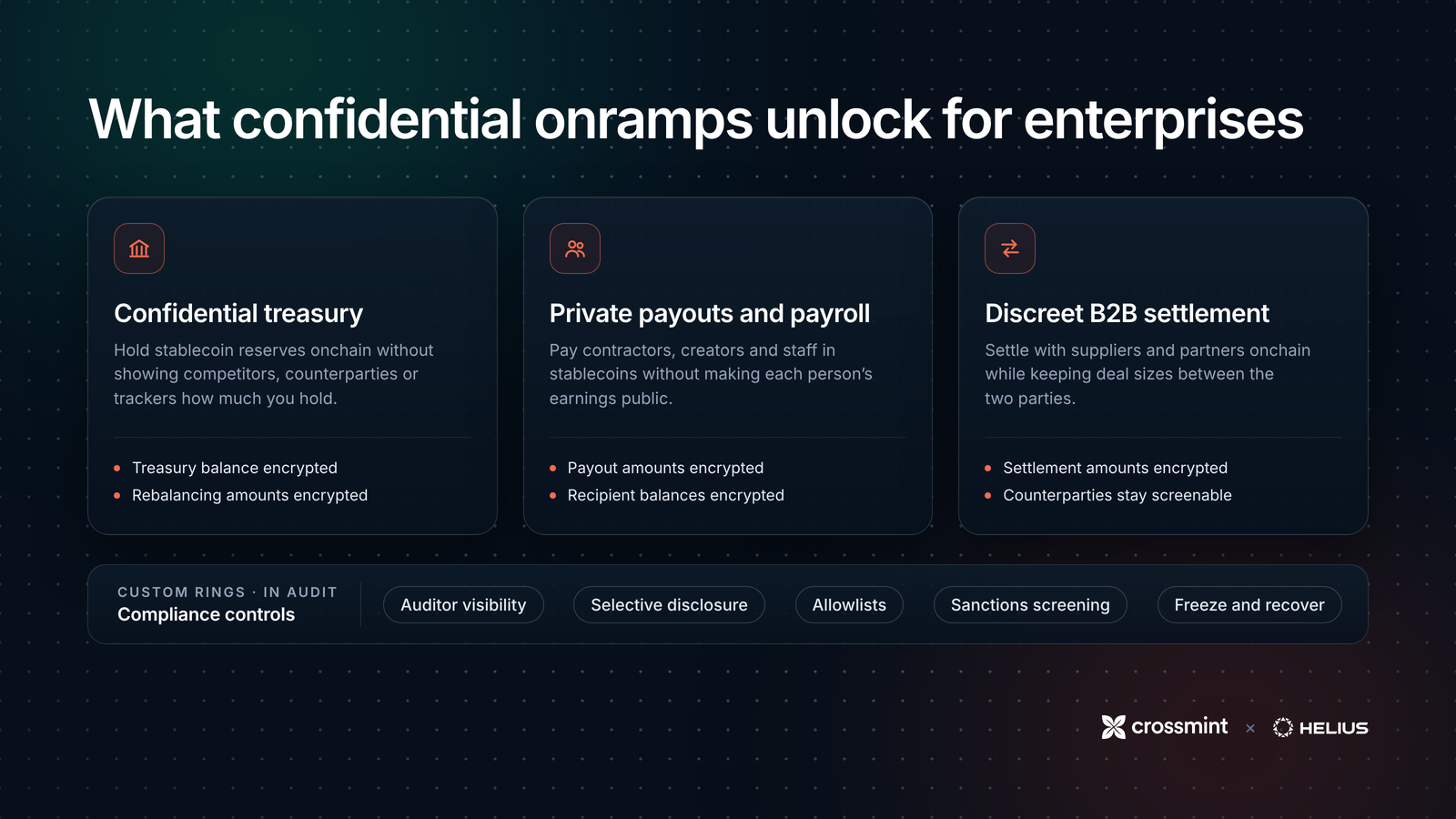
In all three use cases, the Default Ring, Helius’ public Privacy Rings that anyone can use, encrypts balances and amounts but keeps counterparty addresses visible. For regulated businesses, this allows screening and reporting to still work, while the numbers stay private.
Custom Rings will add finer-grained controls enterprises ask for. Helius describes Custom Rings as permissioned environments where an institution sets what is hidden and from whom. Planned controls include auditor visibility into every transaction and balance, selective disclosure to each party, allowlists, sanctions screening, and the ability to freeze and recover funds. Custom Rings are in audit and not yet on mainnet.
Where Crossmint fits today and in the future. Today, Crossmint gets businesses and their users into Privacy Rings with fiat through the confidential onramp. Next, we’re building private treasury and payout flows on Crossmint wallets. If your team needs confidential treasury or payout infrastructure, talk to us.
For developers: enable confidential onramps with one parameter on the order
If you already use Crossmint Onramp, enabling private delivery is just one parameter on the line item:
"executionParameters": {
  "delivery": "private"
}
Leave the field out, or set it to "public", for a regular transfer. Everything else stays the same, the rest of the order, the payment flow, and your webhook handling. To confirm a private delivery, fetch the order and check that lineItems[].executionParams.delivery is "private", and the delivery transaction is the deposit into the recipient's private balance.
| Requirement | Supported today |
|---|---|
| Chain | Solana |
| Tokens | USDC and EURC |
| Order type | Onramp |
| Recipient | A Solana wallet address with a registered Helius Private Wallet |
Your users need a Helius Private Wallet before they buy. Wallets can add one with the Helius Privacy SDK. Crossmint rejects orders whose recipient has no Private Wallet at order creation, and refunds the user if the wallet is missing at delivery.
Full guide: Onramp to Helius Private Wallets.
Compliance by design
Confidential onramping meets the same compliance standard as every Crossmint Onramp order. Sanctions screening, wallet screening, limits, recordkeeping and Travel Rule checks all run before delivery. Privacy applies only afterward, to the user’s balance and what they do with it.
- Same controls. Every order runs the same sanctions screening, wallet screening, limits and recordkeeping as a standard onramp order.
- Auditable delivery. The deposit is a public transaction that shows the recipient, token and amount, so each delivery can be audited like any other.
- Travel Rule ownership proof still works. The Private Wallet uses the same Solana key as the user’s regular address, so users prove ownership by signing with that key, the same way they do for a standard order.
- Self-custodial. The private balance belongs to the user's own wallet. Crossmint can’t spend it, and Helius never receives spending keys.
- Private, not anonymous. Crossmint delivers only into confidential rings, which hide amounts but keep addresses visible. It never delivers into anonymous rings.
What's next: a private end-to-end onramp
Crossmint is building v2 of the confidential onramp with input from Helius, extending privacy to the deposit itself and adding support for more account types.
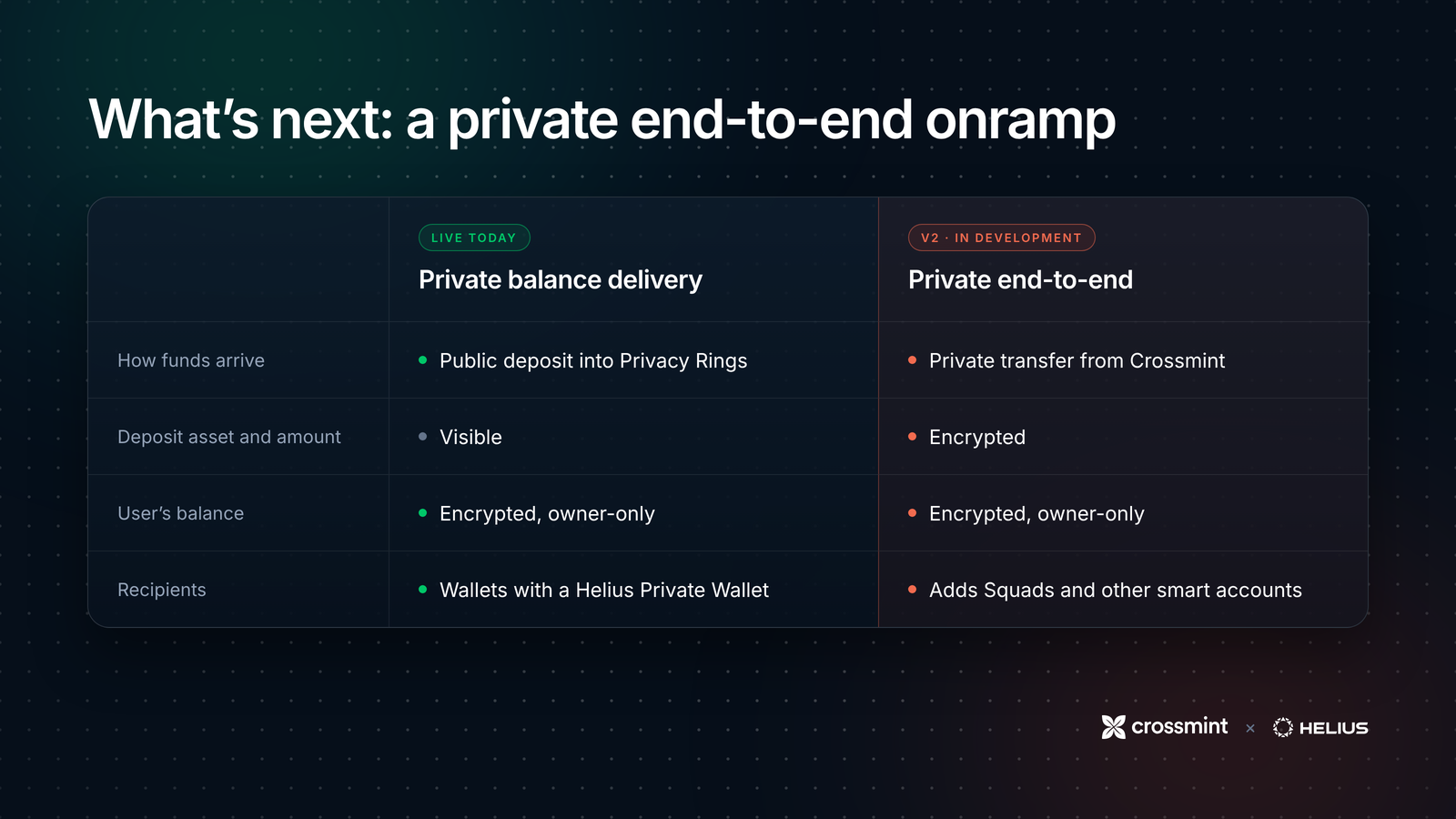
- Encrypted deposits. Crossmint will deliver through a private transfer from its own private balance, so the asset and amount of each onramp are encrypted onchain.
- Smart account and multisig recipients. Teams using Squads and other smart accounts will be able to onramp straight into a private balance.
We will share timelines as v2 gets closer to launch.
Sources
- Solana Privacy Rings bring programmable privacy onchain, Solana Foundation, Nov 10, 2026
- Helius Privacy documentation and concepts
- Confidential fiat on-ramp and off-ramp, Helius docs
- Confidential transfers return to Solana mainnet, Solana Compass
- Onramp to Helius Private Wallets, Crossmint docs